Full text of the feature “Semplice profondità” (Simple depth), Perforare, September–October 2026, pages 118–122. Read the original article with all the photos (PDF).
In geothermal grouting, the system developed by the Villafranca Padovana company makes well cementing remarkably agile. It pairs a proprietary method with a dedicated plant, so work underground is controlled from the surface, with greater reliability and the option of deepening the well later.
In deep geotechnical works and advanced geothermal energy, Dai Prà has developed and filed a method patent application for an innovative deep grouting system. The method was designed for extreme conditions, allowing geothermal wells to be drilled and cemented to depths of up to 2,000 metres. The project grew out of a practical need: making the cementing of deep wells simpler, safer and more efficient. The deeper you go, the greater the technical and operational challenges, from managing pressures to preparing and maintaining cement grouts, to keeping the work continuous without introducing anything that could interfere with the later drilling stages used to deepen the well.
Dai Prà’s solution is the product of an engineering approach built up over years of working with customers and partners on dedicated solutions for complex projects. It combines operational simplicity, reliability, process control and optimised cementing stages, and is designed for both the geothermal and the geotechnical sectors. The method was studied, refined and validated through an international collaboration in Scandinavia, as part of a project to build wells for deep geothermal energy and to develop the sustainable, high-efficiency energy solutions planned for the area.
The method and surface control
At the heart of the innovation is the new working method for deep grouting, supported by a mixing and grouting plant designed and built specifically for it. The approach aims to make cementing much simpler by reducing the need for complex equipment and accessories that have to be placed and managed inside the well. A large part of the work is brought back to the surface, where it can be monitored and controlled more precisely.
The system integrates every stage of the process: from preparing the mix and keeping it homogeneous to high-pressure injection into the casing.
The distinctive feature, and the subject of the industrial method patent application, is the new deep geotechnical grouting method. Grout is pumped under pressure from the top through the casing, which has previously been installed 500 metres into the ground and filled with water, without relying on traditional methods such as packers or other components inside the casing.
Sacrificial separator plugs are inserted from the wellhead and slide down inside the casing; they are designed to eliminate or limit mixing between the water and the cement grout. The same plugs make it possible to pump exactly the quantity of grout needed, and they are designed to be easily drilled out when the well is later deepened, to as much as 2,000 metres. The annulus between casing and ground is filled in a controlled way as the water that occupied the casing is displaced upwards. The water is pushed by the cement grout pumped from the wellhead: the grout first travels down confined between the sacrificial plugs, then exits at the bottom and rises steadily through the annulus to the surface, starting from a depth of 500 metres.
A further advantage is the elimination of critical components inside the casing, such as packers set at the top or at the greatest working depths. Fewer such components means less risk of malfunction, and it also avoids interference with the later drilling stages used to deepen the well.
From design to validation
The method and its plant configuration were put to work in a field trial carried out jointly by Dai Prà engineers and the technical staff of the Scandinavian partner. The results confirmed the reliability of both process and plant and allowed the solution to be validated. Cementing proved uniform, fast and controlled, exactly as designed and implemented.
The main benefits observed include: a simpler execution process, by eliminating operations and equipment otherwise needed downhole; faster work, with the possibility of cementing a well within a single working day, depending on site conditions and the volume to be treated; lower costs than traditional systems that may, for example, use packers at the top or at depth; greater reliability, thanks to fewer critical components and surface control of the process parameters; higher, assured quality, through controlled management of mix preparation, quantities used and pumping parameters; and the possibility of deepening the well later, since no permanent or hard-to-remove components are left inside the casing.
All in one solution
Dai Prà’s project therefore brings together three closely linked elements: an innovative deep cementing method, a plant dedicated to applying it, and a configuration designed for direct use in the field. The experience gained in the international application and the results of the field trial confirm the value of the solution for developing deep geothermal energy and next-generation geotechnical works. The system aims to reduce operational complexity, optimise time and costs and increase the overall reliability of deep cementing work.
A plant designed around the method
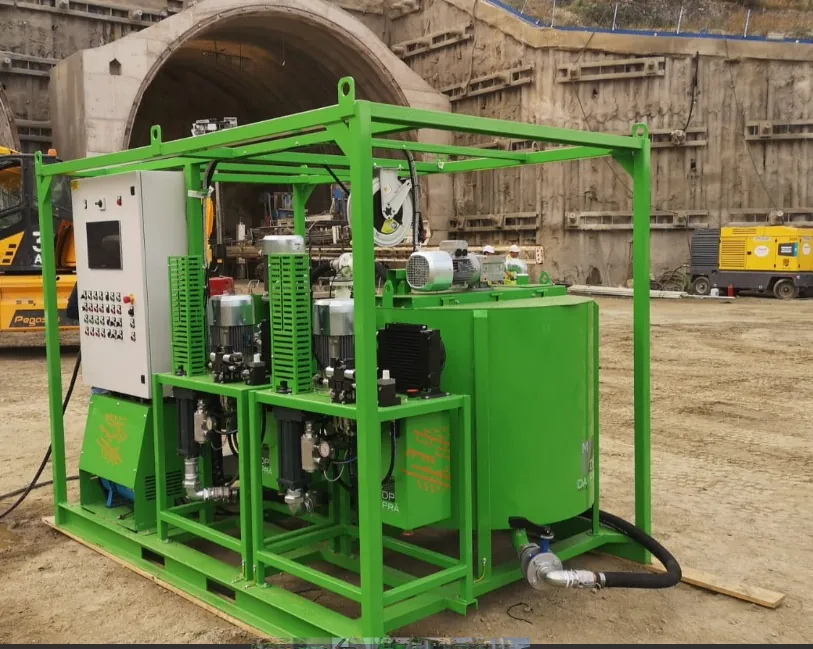
To make the method efficient in practice, Dai Prà developed a mixing and grouting plant as the operational backbone of the patented method. The aim is to ensure automation, continuity and control over the entire cycle, from preparing the mix to injecting it into the casing.
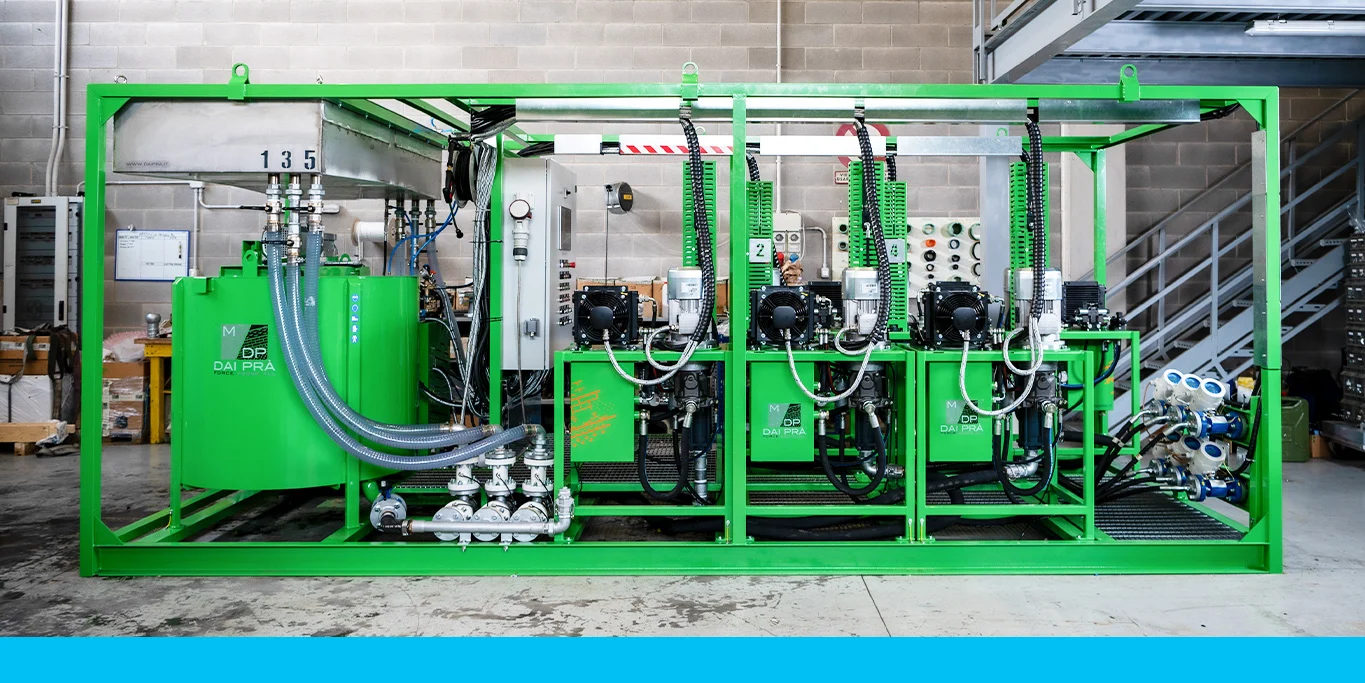
The configuration includes a 1,000 kg big bag discharger feeding the automatic mixing plant with cement/bentonite-based material; a screw conveyor to transport and dose the powder; a high-efficiency colloidal mixer for a homogeneous mix; a controlled additive dosing system; an agitator to keep the grout homogeneous while waiting and during pumping; and an adjustable high-pressure grouting system connected directly to the casing in the ground. The package is completed by a feed head on top of the casing for injection from above, automatic systems for water filling and plant washing, and a generator that makes the system energy-independent. The entire plant was conceived around integration and automation, with the aim of reducing manual operations and making each stage of the work cycle repeatable.
The configuration: containerised and site-ready
The solution is rounded off by a self-lifting containerised configuration, developed for fast set-up directly on site. The main equipment needed to prepare and inject the mix is housed in a single unit. This layout reduces the need for external auxiliary structures and simplifies installation and commissioning. The compact, self-contained configuration is especially suited to projects where site location, operating conditions and the need to keep work schedules short make it essential to have systems that are easy to transport, quick to install and ready to work immediately.
Photos and captions from the feature
The original Perforare PDF contains photos of the system and the field trial, with these captions:
- The control panel with data logger for automatic mixing and grouting.
- Discharging the big bag into the mini silo built into the plant.
- Grout feed head, on top of the casing.
- The self-lifting integrated container.
- The cement grout rising from a depth of 500 metres (filling the annulus between borehole and casing).